
The Speelwijk Fortress A Monument To Dutch Colonial Power In Pamarican, Banten
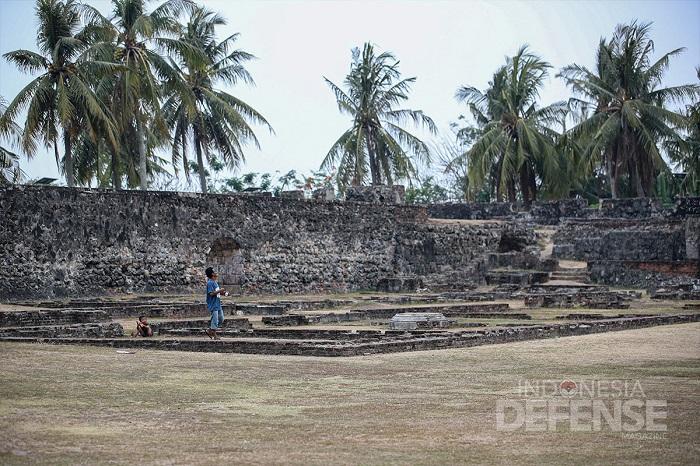
Jakarta, IDM – Speelwijk Fortress is a defensive fortress with sturdy walls and a moat surrounding the primary structure. The building’s outer wall, which is approximately five meters high, still appears upright. At a closer look, the fortress is composed of nearly three meters of brick blended with natural stones such as coral.
Weapons and the chamber of torture
Unlike most European castles, Speelwijk Fortress is rectangular in design, with its important sections arranged side by side rather than upward. It is constructed with a number of rooms and a bastion—an observation tower.
A particularly fascinating part of this fortress is a bunker positioned near the main entrance, shaped like a corridor with two bends. The bunker feels damp as it only has a single ventilation opening at its top. Within the corridor are two rooms used by the Dutch to control the region of Banten.
Read More: Sergeant Major (Retd.) Muchari Malikin Surviving Amid A Hail of Hot Bullets
“The corridor is 13 meters long; this is a weapons storage room, which also served as a chamber of torture in the past,” said Sambudi (58), a fortress guard, pointing to two different-size rooms. The weapons storage room measures only 2x2 meters for storing gunpowder and small weapons. Meanwhile, the other room, with a space of 5x7 meters, at the end of the corridor, witnessed indigenous people being tortured—those who were forced to work,” explained Sambudi.

In the other corner, next to the bunker, there are remnants of various building ruins that were once used as the commander’s apartment, office space, kitchen, and chapel. “This was the commander’s house; next to it was the office, then the kitchen, and in that corner over there was the cannon storage area. Across from it was a church, and in front of it a pole to hoist the flag,” detailed Sambudi.
"The remnants of an old colonial heritage building still stand strong in Kampung Pamarican, Kasemen District, Banten, West Java. Constructed in 1682 by the Dutch, on a two-hectare plot of land, Speelwijk Fortress served as a shelter against the attacks of Sultan Ageng Tirtayasa’s followers. Historical studies reveal how the fortress also served as the Sultanate of Banten’s center of control over a variety of operations, including settlement management. The fortress was named after Cornelis Janszoon Speelman, a Governor-General of the Dutch East Indies."
In addition to these two areas, there are still several sides of Speelwijk Fortress to explore, one being the administrative room, located across the bunker. The room is square-shaped with a locked aluminum door. The fortress strategically faces the sea; in the past, it allowed the Dutch to control access to Banten Port.

On the eastern side of the fortress, the Kerkhoff, a cemetery holding the graves of Europeans who once worked in the Speelwijk Fortress area. “There are about 50 graves here, but only a few with names and dates of death,”said Sambudi.
Read More: Tracing The History of The Siliwangi “Maung” Troop at The Mandala Wangsit Siliwangi Museum
A monument to Dutch dominance
The Dutch built the fortress in the 17th century, during the era of the Sultanate of Banten, under the leadership of Sultan Ageng Tirtayasa. It was designed by a Dutch architect named Hendrik Lucaszoon Cardeel and was soon utilized by the Vereenigde Oostindische Compagnie (VOC) headquarters, determined to monopolize the spice trade.
During this period, the Sultanate of Banten was in turmoil, due to a throne issue. Sultan Ageng Tirtayasa refused to bestow the title of Sultan on his son, Abu Nashar Abdul Qahar, also known as Sultan Haji. The Dutch then took advantage of the conflict, approaching Abu Nashar, his son, known to have a weaker political mindset than Sultan Ageng Tirtayasa’s.
Banten was in turmoil, due to a throne issue. Sultan Ageng Tirtayasa refused to bestow the title of Sultan on his son, Abu Nashar Abdul Qahar, also known as Sultan Haji. The Dutch then took advantage of the conflict, approaching Abu Nashar, his son, known to have a weaker political mindset than Sultan Ageng Tirtayasa’s.
Centuries have passed, yet the remnants of the fortress still exist today, despite the toll taken by time. Several parts of the fortress still exhibit its beauty. The Provincial Government of Banten is now in charge of the Speelwijk Fortress, engaging in periodic maintenance and cleaning to maintain the fortress in a proper condition. The public is welcome to visit Speelwijk Fortress at no cost; it also provides a play area outside its walls. (Ummamah Nisa)
Recommended for You
 HISTORY
Malabar Radio Station “From Bandung to the Netherlands” – Colonial Dutch Communications
 HISTORY
Tracing The History of The Siliwangi “Maung” Troop at The Mandala Wangsit Siliwangi Museum
 HISTORY
The Japanese and Dutch Caves in Dago Pakar The Symbol of Foreign Occupation in The Sundanese Land
 HISTORY
Traces of The Legiun Mangkunegaran’s Glory in The Indonesian Archipelago
 OPINION
A Brief History of Nuclear Weapons and Global Diplomacy (Part II / II)
 OPINION
On Nuclear War – Again? (Part I)
 WORLDWIDE
Quo Vadis, China Taiwan Unification?
 TECHNOLOGY
KAAN Turkey’s First Indigenous Fifth Generation Fighter
 PHOTOSTORY
Palestinian Students In Indonesia: Struggling For Freedom Through Education
 OPINION
Indonesia Must Prepare for the Prospect of Pacific War II
 NATIONAL DEFENSE
Surabaya Central Naval Museum Showcasing History Using Artificial Intelligence
 INTERVIEW-EN
Semar Sentinel Defense Analyst M. Fauzan Malufti: Indonesian Future Leaders Must be More Knowledgeable about Defense
 TECHNOLOGY
Get To Know FREMM, The European Sea Guardian
 PHOTOSTORY
Sergeant Major (Retd.) Muchari Malikin Surviving Amid A Hail of Hot Bullets
 WORLDWIDE
The Blessing and Curse of Being Embraced: Pacific Island Countries in A Competitive Geopolitical Struggle
 TECHNOLOGY
The Super Advanced Turkish-Made ANKA Combat Drone
 TECHNOLOGY
Artificial Intelligence: AUKUS’ Advanced Technology of Choice for Power Projection
National Defense
Surabaya Central Naval Museum Showcasing History Using Artificial Intelligence
The museum, which literally translates as “At sea we are victorious”, was built in 2022, during the tenure of Chief of Naval Staff (KSAL) Adm. (Retd.) Yudo Margono. A year later, on September 11, 2023, the museum was completed and inaugurated by the current KSAL Adm. Muhammad Ali. But it was only open to the general public on January 21, 2024.
Technology
KAAN Turkey’s First Indigenous Fifth Generation Fighter
The first flight lasted 13 minutes and reached a speed of 230 knots at an altitude of 8,000 feet,” read a statement from the manufacturer, state-owned Turkish Aerospace Industries (TUSAS). The KAAN project was launched in 2016 with the aim of replacing Turkish Air Force’s aging F-16 fleet and to be sold to foreign governments.
Photo Story
History
Malabar Radio Station “From Bandung to the Netherlands” – Colonial Dutch Communications
The Malabar station complex contains remnants of the radio station’s former offices and employee residences, in front of the camping and parking area. An information board offers a variety of tourist attractions around Mount Puntang, including coffee tourism, waterfall visits, and cycling tours.